
NOISE
I have never thought that I would need to search for noise-reduction earphones for my baby, even though I live in a small town surrounded by nature.
We react differently to external factors. If we ask different people how they would describe noise, they would assume it is something loud and unpleasant to hear, I guess. I think it is important to add the word unpleasant. Loud music during a concert of your favourite band is something you will surely enjoy, whereas people who live in close proximity to the event won’t like it, particularly if they are trying to make their baby fall asleep. They would call this concert noise.
This would be the first sketch of the definition of noise. Let’s investigate further how such an aspect of our lives as noise is currently perceived by people. Is it taken seriously or simply ignored?
This is perfect timing for me to write on this topic, as I live in a small city in the Tyrolean Alps, close to nature and far from industrial facilities or overcrowded urban areas. This will make my investigation efficient and will definitely bring some interesting insights, because if there is an issue in how this subject is mishandled and wrongly understood in the context of a small town, then we have much bigger problems when considering large cities and environments with high levels of noise in general.
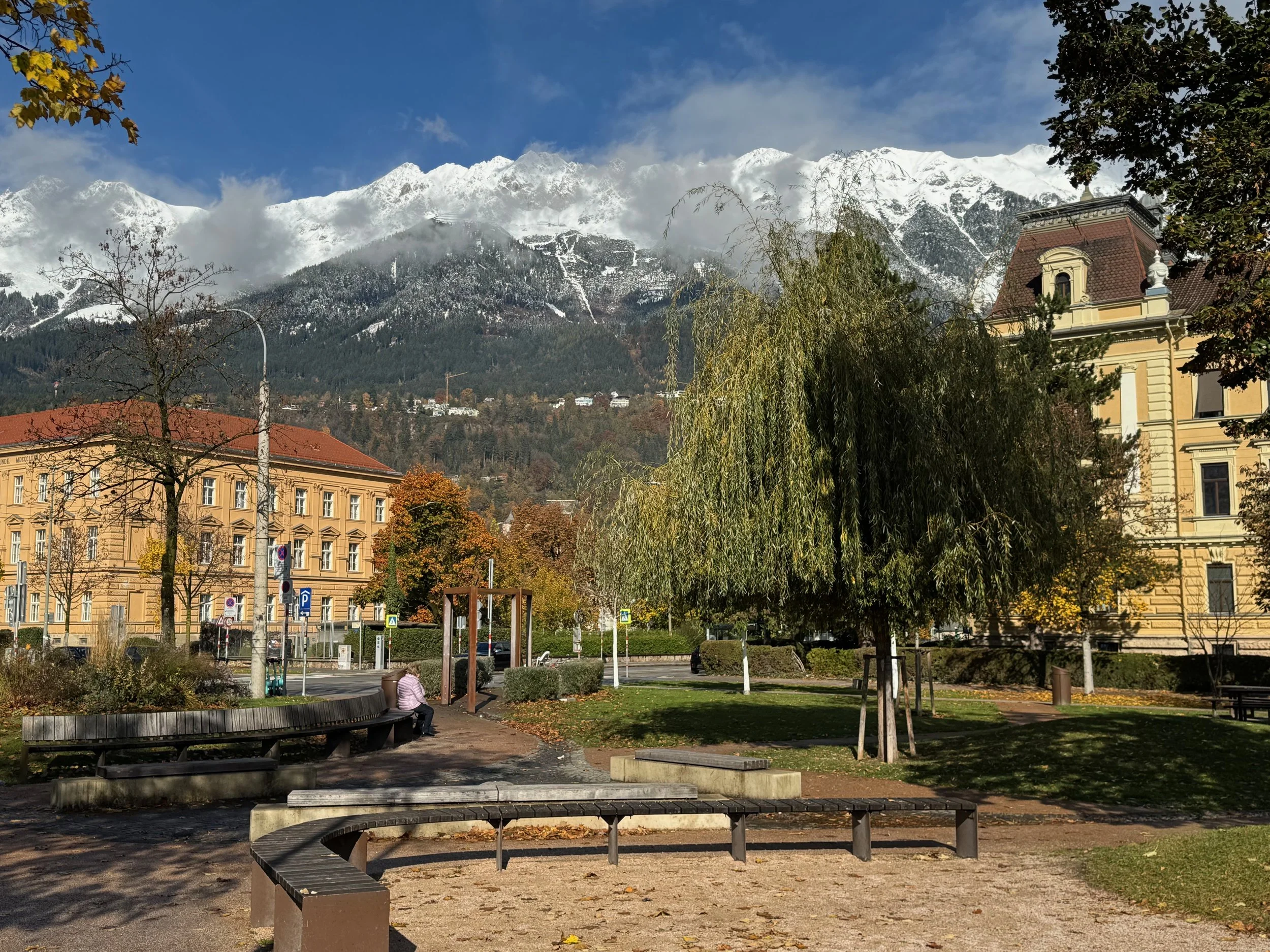
Innsbruck City.
I have no intention for this writing to be academic, and I therefore don’t want to meticulously analyse all subjects relevant to noise. Years would be needed for that. I suggest we rely on the common sense of a generally intelligent person with critical thinking developed to a level sufficient for them to be interested in this topic.
Let’s start with facts, so that we don’t have any doubts or counterarguments during this writing on things that are cast in stone. A large number of people are highly sensitive, and for them the sound level is crucial, as it may affect their health—mental and physical, I assume. The first time I heard of high sensitivity, I thought it was not a scientific fact but rather something used to show that someone is overreacting to a certain external event, be it a sound, smell, or image.
It appeared that various constructs exist among researchers to uncover sensitivity. To me, this is a clear indication of the severity of the question. I have heard many times when people told me that I am an introvert and that is why this question matters to me the most. Although introversion and emotionality might be partially related to sensitivity level, they are not game changers at all. This is a fact, and you can find proof in many studies—for instance, the article by Grant Benham, “The Highly Sensitive Person: Stress and Physical Symptom Reports.”
Let’s try to find what represents sensitivity and whether it can be measured. I did some research and found out that this model actually exists and is called the Highly Sensitive Person Scale (HSPS). The best source for that is the article by Elaine N. Aron and Arthur Aron. It is an older study, published in 1997, but to me it is a good demonstration of how long this subject has been known and, in my opinion, not taken seriously by people, even though it is something related to our health.
Funny, but one should be sensitive in order to be interested in learning about this subject. We are in the minority. There are 20 percent of us—highly sensitive humans—plus 100 other species, according to studies. This is a fact. Let’s go slightly deeper and finalise this thought with another fact. The reason highly sensitive people react differently to intense stimuli or noise is because our brains operate differently.
When we are uncomfortable hearing a siren or seeing a bright light, our brain experiences higher activation and more regions are involved than in those other 80 percent of people who just hear the siren. We react in a more intense way to the irritative factor. This is biology, and there is no need to cover this with words such as “introvert” or “emotional”.
If we are overwhelmed by sudden noise, there is a high chance that we are among that 20 percent.
But while on the one hand it is essential to be aware if you are sensitive to noise, on the other hand—the bigger problem—is for us to understand the root cause of the noise. Why is it allowed that a siren is howling in a quiet neighbourhood, airplanes are landing just a hundred meters above the heads of citizens, and churches are loudly ringing bells after 9 pm? How does all this fit together?
From people around me, and I guess some of them are among the 80 percent, I often hear this excuse: the siren is for our safety, as the driver makes it clear for everyone that there is an emergency. Airplanes in Innsbruck normally land at an airport in close proximity to the city—a 10-minute drive—and it has historically been like this. Moving the airport would be expensive. Churches—our traditions—ring as they used to. I don’t think this is reasonable to give reasons like that.
I just want to take these three examples and look at them carefully. Plus, I would also like to add some extra thoughts as an architect on the topic of noise as part of the built environment.
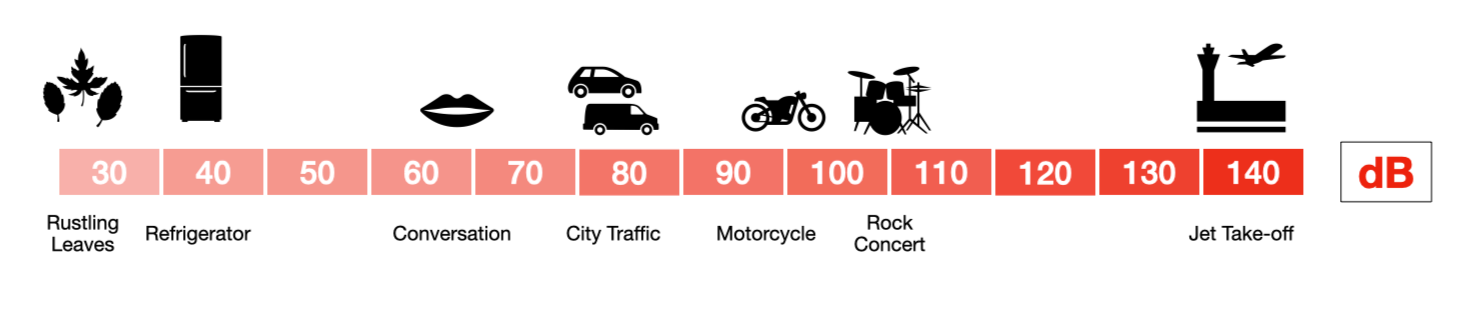
Sirens. I am not an expert in electronics or emergency situatiozcns, but I want to look at the physics and logic behind them. In Innsbruck, for example, I hear sirens around five times per day. This is around 110 dB if the vehicle is passing very close. The volume is similar everywhere—quiet neighbourhoods, city centre, night, day. It doesn’t matter—they have rules. You cannot question these rules because it is about safety. But maybe we should question them and make this more human.
I understand when the ambulance is passing me at a speed of 80 km/h with a loud siren. They are in a rush and want to prevent any possible accident on the road, as the driver is at maximum focus. In Innsbruck, I often see ambulances passing by at a speed of 30–40 km/h, or in my neighbourhood where there is traffic with one car per hour and they are using the same volume of the signal. Shouldn’t we take this case, coordinate it with authorities, and adjust these rules to make everyone comfortable?
Airplanes. If you are in Innsbruck city centre on a Saturday during winter season, you will hear airplanes landing around every 30 minutes. The thing is, it is so close that you can almost feel the airflow from the plane. I measured the sound—it is around 100 dB.
My quiet neighbourhood
They say that this is the only place for an airport in the valley, as the rest is difficult terrain with high mountains. I think the reality is different, and moving the airport away from the city would cost a lot—indeed, a lot. But does that “a lot” equal human health? I don’t want to sound naive, and I am not trying to find the ultimate truth. What I want is to accept real reasons and not be given protective excuses that airplanes passing over our heads are fine. They are harmful, and the extent can be measured, whether we are sensitive or not. I am not even touching the question of general safety having aircrafts landing and taking off few hundred meters above the city.
Churches. I grew up in Russia in a small town. I love the melody of church bells when they are not loud and are skilfully managed by those in charge. There is an interesting word for that—tintinnabulation. It reminds me of tradition and the beauty of religious beliefs. What I hear here in the beautiful city of Innsbruck is bum, bum, bum, particularly at 12, 3, and 7 o’clock—extremely loud noise from bells scattered everywhere. No melody. It reminds me of someone hitting a hanging piece of metal like a frying pan to scare an approaching animal. I understand that there is a tradition of ringing bells, but in the past this served a function—to inform people.
Church in my neighbourhood in Innsbruck City.
Nowadays, this type of information is outdated and can be reduced to occasional events and considerably lower sound levels. I wonder how many babies have been woken up by this noise. Our baby is woken up at least three times a week, and he strongly reacts with tears and screaming. Traditions should not necessarily be kept to the same extent. We can adjust and preserve them reasonably and with respect for everyone.
I wanted to give only those three notable examples, but now I want to say a bit more.
Motorcycles, or why would anyone intentionally create noise of that level? Around twenty percent of us know how annoying it is to hear extremely loud noise from a motorcycle passing by, particularly those machines with obvious modifications of the engine sound. Owners of these two wheels are definitely not aware of what respect means. I measured the noise level—around 100 dB.
I wonder what all those authorities responsible for vehicle control do and why they allow these means of transport in cities. Governments are so concerned with EV and CO₂ but completely ignore checking how much damage the two wheels may cause to people. I am not saying that they should be banned. Yet they can be asked to follow certain allowed levels of noise. A city is not for motor racing.
Kinder playgrounds just in front of quiet residential buildings—bad idea and unfortunately ubiquitous around the globe. Many design solutions can be found on how to tackle this. Let’s learn from the best Scandinavian practices.
Chair legs made out of steel which scratch inappropriate floor surfaces. Yes! Even this is worth paying attention to. It is simple to solve.
Have you ever heard a chair scratching the floor at a high-level dinner of country leaders? I don’t think so, because in that environment organisers care and think about the elite, whereas people at a lower level don’t care about themselves. Are we still peasants?
Helicopters passing over cities just for entertainment and showing tourists the area from above. Shall we reconsider this? I hope oil prices will self-regulate this and this kind of fun will slowly turn into something more sustainable.
Barking dogs everywhere—all these contribute to the overall noise and can be handled if accepted by people and taken seriously. Maybe people will start to train their dogs if they live among others.
People’s mentality in general, when they loudly laugh or shout while passing a baby in a stroller, is a much bigger concern, which relates to intelligence in general and will take tens of years for those in need to realise how severe the noise problem is. I wonder if it will ever change. But this is part of a bigger psychological and social study.
etc. etc. etc.
When I was responsible for coordinating noise-reduction strategies while working on an industrial building design project, I came across a life-changing course by Acoucou. I provided the link below. It offers some of the best explanations of noise management. I would recommend everyone—even those not in the construction industry—to read it. It is interactive and simple to understand. It is a fantastic initiative, partially funded by the Erasmus + Programme of the European Union. To me, this material is not just for industry—it gives an opportunity to reflect on how important the noise aspect is in our lives.
Design companies produce acoustic calculations to demonstrate that internal sound levels are acceptable and do not harm people. All of that is based on building physics. In practice, however, when we are talking about a larger scale and external street noise levels, it doesn’t work, as for some reason we focus on industry specifics and forget about urban noise management. How are all those cases I listed in my previous writing tackled by municipalities? What is the high-level strategy?
“The World Health Organization (WHO) has classified noise as the second most important cause of ill health in Western Europe, behind only air pollution caused by very fine particulate matter” - Acoucou.
With this in mind, I would assume that the EU is supposed to take ALL types of noise seriously and show us how they care about the rule of law and people’s health. As of today, the noise issue is taken seriously on paper. Yet the reality is very different.
Whenever there is a need to justify annoying noise from churches or airplanes, these norms turn into recommendations and are eventually completely ignored. This is not the rule of law - this is chaos and a lie from authorities who still convince the majority that Dmitry’s (author of this writing) temperament is closer to that of an introverted and emotional person, and that there is no issue or harm. There is an issue, and there are simple ways to measure it—in dB.
I was very reluctant to look at the regulations or laws that govern noise. In particular, I had no doubt about the lack of coherence and simplicity in terms of how this question is handled by the European Commission. I don’t know why. Maybe if I had been more positive, I would have found a better answer.
I want to summarise very briefly here how, in my opinion, this question is approached, at least here in the EU. This will be a very simplified view, but I believe it captures the essence. Some people may say that complex questions like this do not have a simple solution, but I strongly disagree. This question can be solved in a more human way, not only on paper by commissions and member states, but by actually reducing the environmental noise people are exposed to.
It was a big surprise to me when I started to read about existing plans to reduce noise levels and found out that in Austrian Tyrol there was a law that bans motorcycles which produce more than 95 dB. A good measure, I thought. But in practice, when we look deeper, this law requires owners only to have the noise level of the engine specified in the registration card. There is no need to measure it and demonstrate how much noise is actually produced! This law was written when the public complained about noise from motorcycles, as I do. But why 95 dB, and why is it only required to be shown on paper? What sense does it make? How did it reduce the noise on the street? Is there any report on that? I haven’t found anything!
Old Vespas commonly have approved noise values around 82–86 dB(A). But the thing is that, over time, exhaust deterioration occurs and they may produce more decibels. The interesting thing is that a difference of 10 dB is perceived roughly as a doubling of loudness. You can see prove of that in the article by S.S. Stevens.
So, back to legislation. The organisation at the top of the chain is the WHO. It gives some RECOMMENDED values for noise levels that are better not to exceed. You can check this one if you want: Environmental Noise Guidelines for the European Region – 30 January 2019 | Guideline.
The European Commission takes those numbers and translates them to member states, asking them to protect human health through action planning, mapping, and reporting. Yet, there are no specific requirements specified in the document and it covers only some sources of noise. You can have a look; it is very general and confusing to read: Directive 2002/49/EC of the European Parliament and of the Council of 25 June 2002 relating to the assessment and management of environmental noise.
If we take the definition of noise from this law, I do not understand how noise from many activities such as churches, concerts, sirens, etc. is taken into account. Environmental noise should not only mean traffic or industry!
“(a) "environmental noise" shall mean unwanted or harmful outdoor sound created by human activities, including noise emitted by means of transport, road traffic, rail traffic, air traffic, and from sites of industrial activity such as those defined in Annex I to Council Directive 96/61/EC of 24 September 1996 concerning integrated pollution prevention and control(12);”
What happens next is that this directive is taken by member states. For example, in Austria, implementation of this directive focuses on mapping noise, identifying affected populations, and creating action plans. What about requirements in practice and checking how those requirements are implemented? Any real measures? We can report anything, but how is all this measured and controlled? I looked at one of numerous sources but did not understand anything.
I will give an example. Innsbruck Airport. Do you remember the noise I was talking about before? Innsbruck has around 130,000 people. Innsbruck Airport is not classified as a “major airport” under the EU Directive because EU mapping obligations start at 50,000 aircraft movements per year. That’s it. Enjoy the noise!
This is, briefly, about the RULE OF LAW with regard to exposure to the sounds around us. While writing this, I have heard dozens of airplanes, loud garbage trucks (why are they still not electric?), church bells, and ambulances—all of them man-made and all of them should be evaluated by urban planners and considered as a potential threat to human health. Even with a simple app in my hands I was able to identify several sources of extremely loud noise.
Governments should protect people from excessive noise in a similar way as they protect them from crime. Noise safety is as important as other forms of our security.
Some sources I would like to mention:
https://www.hsperson.com/pdf/JPSP_Aron_and_Aron_97_Sensitivity_vs_I_and_N.pdf
https://onlinelibrary.wiley.com/doi/epdf/10.1002/brb3.242
https://aci.acoucou.org/materials/intro
https://www.who.int/europe/publications/i/item/9789289041737
https://environment.ec.europa.eu/topics/noise/environmental-noise-directive_en
https://www.tirol.gv.at/arbeit-wirtschaft/esa/laerm/umgebungslaerm/